
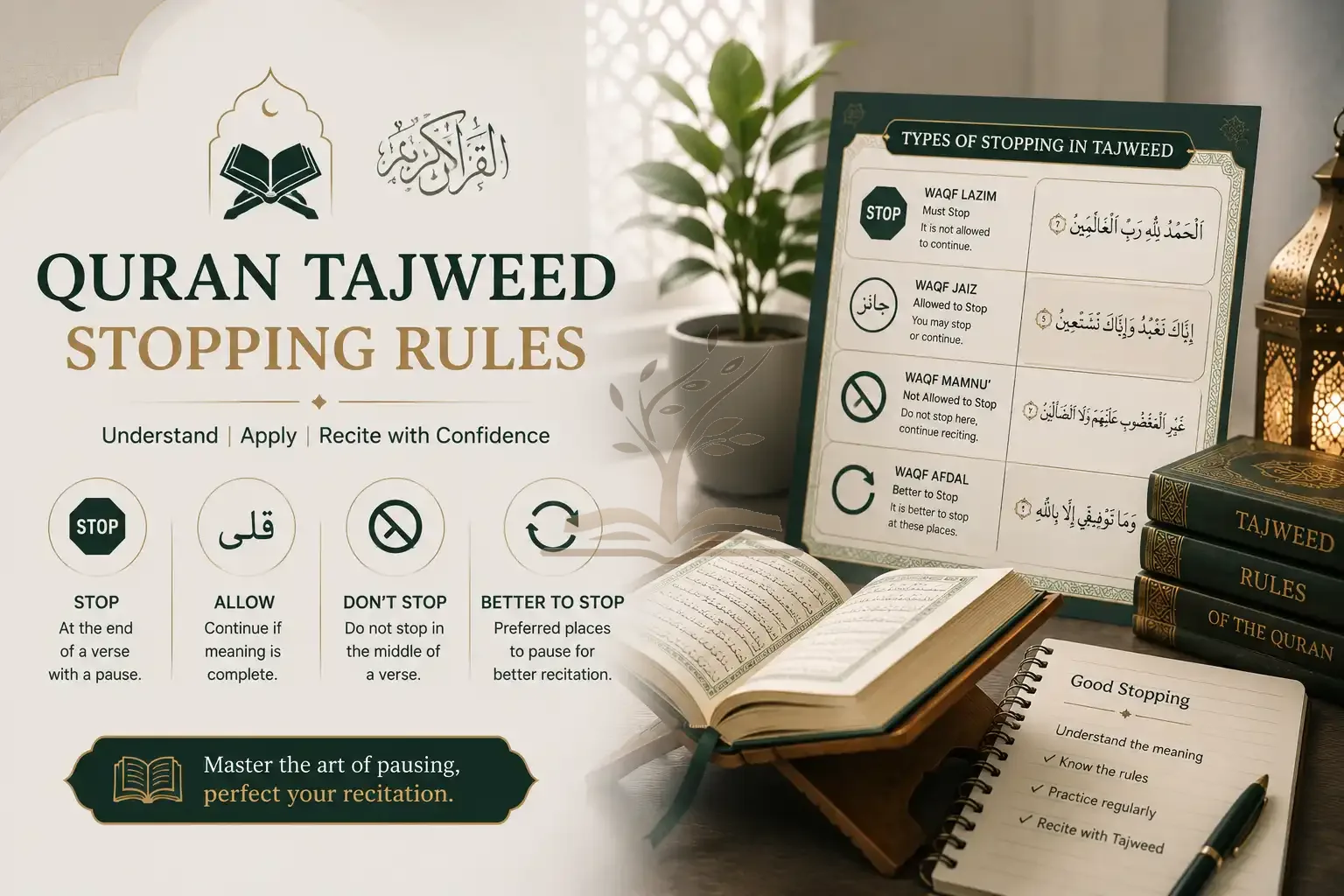
A good grasp of the Quran tajweed stopping rules is important for anyone seeking to recite the Holy Quran properly and understand it better. Rules of Tajweed maintain the divine message’s meaning while enhancing the spiritual experience of recitation; stopping rules in Tajweed are one of these essential principles to be considered. Let’s break out stopping rules, demonstrating their meaning, importance, what they are, and how to ensure your reading is with proper pauses that reflect on Allah’s words.
What Is the Meaning of Quran Tajweed Stopping Rules?
They are called in Arabic “Waqf,” which means stopping. When you pause during Quranic recitation at specific points, it's important in Tajweed because it maintains the integrity of the text’s meaning, a core concept emphasized in specialized Tajweed courses. In case a reciter overlooks the Quran tajweed stopping rules, they may unintentionally change the meaning of the verse and the overall intended message.
For instance, there is a verse in Surah Al-Baqarah that says:
﴿۞ إِنَّ اللَّهَ لَا يَسْتَحْيِي أَن يَضْرِبَ مَثَلًا مَّا بَعُوضَةً فَمَا فَوْقَهَا ۚ فَأَمَّا الَّذِينَ آمَنُوا فَيَعْلَمُونَ أَنَّهُ الْحَقُّ مِن رَّبِّهِمْ ۖ وَأَمَّا الَّذِينَ كَفَرُوا فَيَقُولُونَ مَاذَا أَرَادَ اللَّهُ بِهَٰذَا مَثَلًا ۘ يُضِلُّ بِهِ كَثِيرًا وَيَهْدِي بِهِ كَثِيرًا ۚ وَمَا يُضِلُّ بِهِ إِلَّا الْفَاسِقِينَ﴾
(Indeed, Allah is not timid to present an example - that of a mosquito or what is smaller than it. And those who have believed know that it is the truth from their Lord. But as for those who disbelieve, they say, "What did Allah intend by this as an example?" He misleads many thereby and guides many thereby. And he misleads not except the defiantly disobedient.)
In the Quranic text, if you stop on (إِنَّ اللَّهَ لَا يَسْتَحْيِي) you mean this as an insult. That’s why you should know where to stop and when it’s forbidden to stop.
Why Stopping Rules Matter in Quran Recitation
The Quran tajweed stopping rules are important, as they are not just a technical requirement; they are also a crucial factor that maintains the meaning and beauty of Quranic recitation. Understanding these rules is a vital step when learning how to study islam at home, ensuring your independent or guided recitation remains accurate and clear.
Following Prophetic Recitation
Proper stopping follows the way of recitation established by the Prophet Muhammad (PBUH), which means it ensures authenticity.
Maintaining the Verses’ Meaning
Stopping rules maintain the Quranic meaning, as correct waqf ensures that the sacred text is recited in a way that maintains its message and prevents any misinterpretations. It also avoids the distortion of Quranic meaning by ensuring pauses are at the right points.
Improved Understanding
Proper stopping ensures that verses are understood within their proper context, which helps with deeper understanding of the whole message.
Maintaining Authenticity
The Holy Quran should be read as well as our prophet Muhammad (PBUH); we should maintain this way that was preserved through generations of scholars.
Better Spiritual Impact
Stopping at specific points gives you time to understand and ponder the meanings of this verse, improving the spiritual experience of Quranic recitation and connection with Allah.
Quran Tajweed Stopping Rules
The Holy Quran has its own reading principles, which should be taken into consideration while reading. The Quranic text has some necessary stop and pause signs so that the reciter comprehends its meaning correctly. Here are Quran tajweed stopping rules in detail:
-
Necessary Stop (Waqf Laazim)
A stop is necessary to avoid changing the intended meaning; its symbol is م (Laazim) or لا. Continuing without can lead to incorrect interpretation.
-
Forbidden Stop (Waqf Qabih)
Pausing at these points distorts the meaning and leads to misunderstandings. There are some verses where you must keep reading to maintain the meaning as clear and flowing.
-
Complete Stop (Waqf Taam)
It indicates that the meaning of the verse is complete and the idea fully independent. Once you see م (Maqtu’a), it means you must pause here.
-
Sufficient Stop (Waqf Kafi)
It means the meaning is complete, but the verse is still connected to what follows. Consequently, it’s preferred to stop at this verse but with an awareness of the continuation of meaning in the next verse. Its symbol is ك.
-
Good Stop (Waqf Hasan)
You can pause when you find this symbol ح, but it is also okay to keep reading. In a good stop, it is acceptable to stop here because the meaning is complete.
-
Al-Wasl Awlaa
It means that if there is a stop, it’s preferred to keep reciting without a pause for a smoother meaning.
-
Optional Stop
Scholars encourage stopping here. The reader is free to choose.
-
Brief Pause (Saktah)
By concentrating on the following words and stopping without taking a breath, the recitation gets more flowy.
-
Permissible Stop (Waqf e Jaaiz)
A reciter can stop, but he doesn’t make it necessary.
Read: read and memorize quran online academy
Stopping Signs in the Quran
|
Symbol |
Meaning |
Example |
|
م (Meem) |
Must stop |
"الْحَمْدُ لِلَّهِ رَبِّ الْعَالَمِينَ م" |
|
ق (Qaaf) |
Similar Stop (like Meem stop but less strickt.) |
"مَالِكِ يَوْمِ الدِّينِ ق" |
|
ط (Taa) |
Permissible Stop |
"إِيَّاكَ نَعْبُدُ وَإِيَّاكَ نَسْتَعِينُ ط" |
|
ص (Saad) |
Preferred Stop |
"اهْدِنَا الصِّرَاطَ الْمُسْتَقِيمَ ص" |
|
ج (Jeem) |
Optional Stop |
"الَّذِي خَلَقَ السَّمَاوَاتِ وَالْأَرْضَ ج" |
|
لا (Laa) |
Forbidden Stop |
"اللَّهُ يَعْلَمُ لا" |
|
ز (Zay) |
Recommended Stop |
"رَبِّ الْعَالَمِينَ ز" |
|
س (Seen) |
Brief Stop |
"إِنَّ اللَّهَ س" |
|
قف (Qaf) |
Pause Here |
"وَاللَّهُ أَعْلَمُ قف" |
|
صل (Sala) |
Continue |
"اللَّهُ أَعْلَمُ صل" |
|
قلي (Qali) |
Stop briefly |
"رَبِّ الْعَالَمِينَ قلي" |
Tips for Mastering Quran Stopping Rules
The Quran tajweed stopping rules can look difficult in the beginning. As a Quran learner, you should emphasize this fact; practice can make you master any rule. Here are some tips that can help you out:
- Start practicing on short Surahs and mark every stop symbol manually until you remember them and their locations.
- Listening is the best way to improve your reciting of the Holy Quran; listen to expert reciters for auditory learning throughout your day.
- Stimulate your brain by using colors and highlighters while studying to recognize the symbols more easily.
Improve Your Fluency with Correct Quran Stops
If you are interested in deepening your skills, Athar Academy stands as a leading online Quran academy, providing affordable packages with the highest quality. Our Tajweed course can address your pitfalls systematically. Contact us today!
Conclusion
By applying the Quran tajweed stopping rules, you will honor the Quran’s sanctity and get closer to enhanced comprehension and deeper spiritual connection with Allah.